Get in Touch

Ready to take your business to the next level? Fill out the form below, and we'll get back to you as soon as possible. We look forward to hearing from you!

Flutter vs React Native in 2024: Which Cross-Platform Framework Wins for Enterprise Apps?

Quick Answer

Flutter is generally the stronger choice for enterprise apps prioritizing pixel-perfect UI consistency across platforms, animation-heavy interfaces, and long-term performance, since it renders its own UI directly rather than relying on native components. React Native is the stronger choice for teams with existing JavaScript and React expertise, faster initial ramp-up, and apps that benefit from feeling native to each platform’s design conventions. Both frameworks save 30 to 60% in development cost compared to building separate native iOS and Android apps, and both are genuinely production-ready for enterprise use in 2024.


Published February 6, 2024 by Jordan Mills, Lead Engineer at NCM Technology — 9 min read

Introduction

Choosing between Flutter vs React Native for Enterprise development is one of the most consequential early decisions in a mobile app project, and it has become considerably less clear-cut as both frameworks have matured. Both can now reliably support serious, high-traffic enterprise applications — the decision is less about which framework is fundamentally better and more about which one fits your team and your specific app requirements.

This guide breaks down the real differences that matter for enterprise decision-makers evaluating cross-platform mobile app development in 2024, based on what we see working across client projects at NCM Technology.

 

Flutter vs React Native comparison for enterprise mobile apps


What Each Framework Actually Is

Flutter, developed by Google, uses the Dart programming language. Flutter renders every pixel directly through its own graphics engine rather than relying on native platform components, which gives it complete control over the UI rendering pipeline and results in highly consistent visual output across iOS and Android.

React Native, developed by Meta, uses JavaScript and the React framework. Rather than rendering its own UI, React Native maps components to actual native platform elements — a React Native button becomes a real native button on each platform. This gives apps a more platform-authentic feel by default, since the underlying components are the genuine native ones.

Performance — What Actually Matters for Enterprise Apps

Historically, Flutter held a meaningful performance edge due to its direct rendering approach, while React Native’s older architecture relied on a JavaScript bridge that could introduce latency for complex interactions. This gap has narrowed considerably as React Native’s tooling has matured.

For the vast majority of standard enterprise application patterns — forms, lists, navigation, typical business workflows — both frameworks now deliver smooth, responsive performance. The difference becomes more noticeable specifically in animation-heavy or graphics-intensive interfaces, where Flutter’s direct rendering approach tends to hold a measurable advantage. For a standard internal tool, B2B portal, or typical customer-facing app without heavy custom animation, performance alone should rarely be the deciding factor between the two.
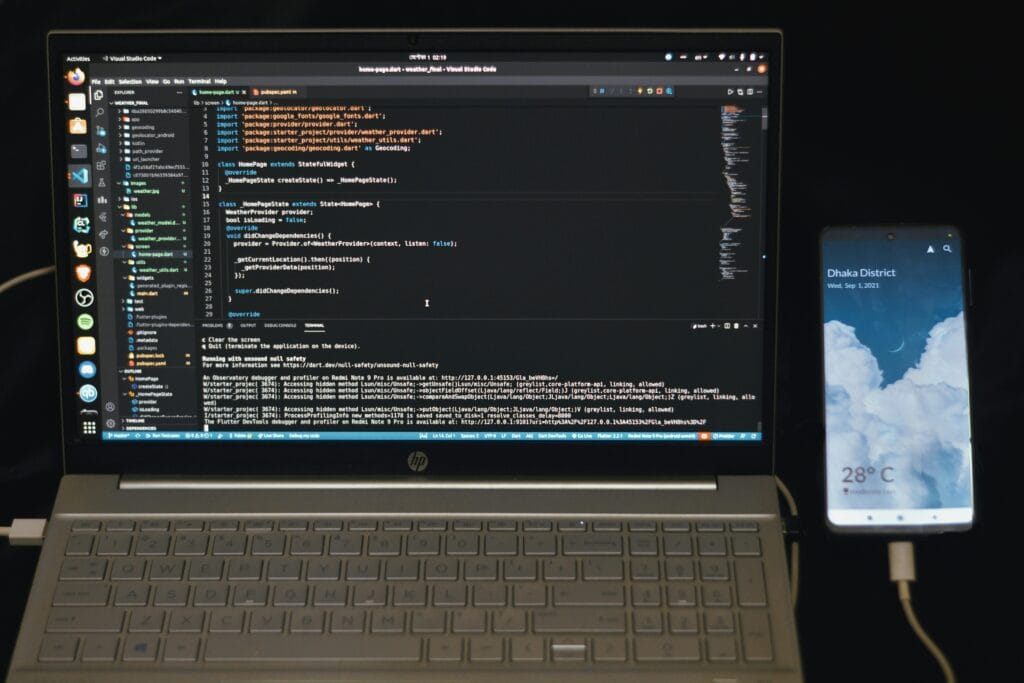
 

Cross-platform mobile app development with Flutter and React Native


Where Flutter Tends to Win

  • UI consistency across platforms — because Flutter draws its own UI rather than using native components, an interface looks and behaves identically on iOS and Android, which matters significantly for brands with strict design system requirements
  • Animation-heavy interfaces — Flutter’s rendering approach handles complex, layered animations more consistently than React Native’s native-component-based model
  • Multi-platform reach beyond mobile — Flutter supports web and desktop targets from the same codebase, which can be valuable for enterprise tools needing a consistent experience across device types
  • Long-term maintenance predictability — because Flutter is insulated from platform-level UI component changes, OS updates are less likely to introduce unexpected breaking changes to the rendered interface

Where React Native Tends to Win

  • Existing JavaScript or React expertise — a team already working in React on the web can extend that knowledge to React Native with a meaningfully shorter ramp-up period than learning Dart from scratch
  • Hiring speed and talent pool size — JavaScript developers significantly outnumber Dart developers, making it generally faster and more straightforward to scale a React Native team quickly
  • Apps wanting a platform-authentic feel — because React Native components map to real native elements, apps automatically pick up platform-specific look, feel, and navigation conventions without extra work
  • Ecosystem breadth via npm — React Native benefits from the much larger general JavaScript package ecosystem, making certain integrations and tooling easier to find

The Cost and Talent Trade-off

Both frameworks deliver real cost savings of roughly 30 to 60% compared to building and maintaining fully separate native iOS and Android codebases — this is the core value proposition both share, regardless of which one you choose. The more relevant cost factor for most enterprise decisions is team composition: if you already have strong React or JavaScript developers, React Native typically gets you to a working product faster with lower initial ramp-up cost. If you are starting fresh or building a longer-term, design-intensive product, investing in Flutter and Dart training can pay off through better long-term UI consistency and maintenance predictability.

According to Stack Overflow’s 2024 Developer Survey, Flutter and React Native run nearly neck and neck in usage among professional developers, with the gap between them narrow enough that team fit and project requirements should outweigh general popularity trends when making the decision.

 

Choosing the right cross-platform framework for an enterprise mobile app


A Simple Decision Framework

Choose Flutter if: your app has strict brand and UI consistency requirements, involves complex custom animations, or you want a single codebase covering mobile and potentially web or desktop in the future. Choose React Native if: your team already has strong React or JavaScript skills, you need to hire and scale a development team quickly, or feeling native to each platform’s conventions matters more than perfect cross-platform visual consistency.


Frequently Asked Questions

Which framework is faster to develop with: Flutter or React Native?

For teams with existing JavaScript or React experience, React Native is typically faster to get started with, since there is no new programming language to learn. For teams starting fresh with no strong preference either way, both frameworks offer comparable development speed once the team is past the initial ramp-up period, particularly with Flutter’s hot reload and React Native’s fast refresh both supporting rapid iteration.

Is Flutter or React Native better for a brand-heavy consumer app?

Flutter generally has an edge here, since its direct rendering approach allows pixel-perfect consistency with a custom design system across both iOS and Android. React Native can achieve similar results but typically requires more custom styling work to override default native component appearances on each platform.

Which framework has better long-term support for enterprise apps?

Both Flutter and React Native are backed by major technology companies — Google and Meta respectively — and both are used in production by large enterprises. Neither carries meaningful platform abandonment risk as of 2024, and the choice should be based on team fit and cross-platform mobile app development requirements rather than concern over long-term framework viability.

Can I switch from one framework to the other later if needed?

Technically yes, but it effectively means a rewrite of the application’s front-end layer, since the two frameworks use entirely different languages and rendering approaches. This decision is worth making carefully at the outset rather than assuming an easy migration path later.

How much does a Flutter or React Native enterprise app typically cost?

Enterprise cross-platform mobile app development typically ranges from $60,000 to $250,000 depending on feature complexity, integrations, and design requirements, with both frameworks falling into a similar overall cost range for comparable scope.

 
Planning an enterprise mobile app?

NCM Technology builds custom Flutter and React Native applications and will recommend the right framework based on your team and product requirements.


 

6 min read

Flutter vs React Native in 2024: Which Cross-Platform Framework Wins for Enterprise Apps?

Quick Answer

Flutter is generally the stronger choice for enterprise apps prioritizing pixel-perfect UI consistency across platforms, animation-heavy interfaces, and long-term performance, since it renders its own UI directly rather than relying on native components. React Native is the stronger choice for teams with existing JavaScript and React expertise, faster initial ramp-up, and apps that benefit from feeling native to each platform’s design conventions. Both frameworks save 30 to 60% in development cost compared to building separate native iOS and Android apps, and both are genuinely production-ready for enterprise use in 2024.


Published February 6, 2024 by Jordan Mills, Lead Engineer at NCM Technology — 9 min read

Introduction

Choosing between Flutter vs React Native for Enterprise development is one of the most consequential early decisions in a mobile app project, and it has become considerably less clear-cut as both frameworks have matured. Both can now reliably support serious, high-traffic enterprise applications — the decision is less about which framework is fundamentally better and more about which one fits your team and your specific app requirements.

This guide breaks down the real differences that matter for enterprise decision-makers evaluating cross-platform mobile app development in 2024, based on what we see working across client projects at NCM Technology.


Flutter vs React Native comparison for enterprise mobile apps


What Each Framework Actually Is

Flutter, developed by Google, uses the Dart programming language. Flutter renders every pixel directly through its own graphics engine rather than relying on native platform components, which gives it complete control over the UI rendering pipeline and results in highly consistent visual output across iOS and Android.

React Native, developed by Meta, uses JavaScript and the React framework. Rather than rendering its own UI, React Native maps components to actual native platform elements — a React Native button becomes a real native button on each platform. This gives apps a more platform-authentic feel by default, since the underlying components are the genuine native ones.

Performance — What Actually Matters for Enterprise Apps

Historically, Flutter held a meaningful performance edge due to its direct rendering approach, while React Native’s older architecture relied on a JavaScript bridge that could introduce latency for complex interactions. This gap has narrowed considerably as React Native’s tooling has matured.

For the vast majority of standard enterprise application patterns — forms, lists, navigation, typical business workflows — both frameworks now deliver smooth, responsive performance. The difference becomes more noticeable specifically in animation-heavy or graphics-intensive interfaces, where Flutter’s direct rendering approach tends to hold a measurable advantage. For a standard internal tool, B2B portal, or typical customer-facing app without heavy custom animation, performance alone should rarely be the deciding factor between the two.


Cross-platform mobile app development with Flutter and React Native


Where Flutter Tends to Win

  • UI consistency across platforms — because Flutter draws its own UI rather than using native components, an interface looks and behaves identically on iOS and Android, which matters significantly for brands with strict design system requirements
  • Animation-heavy interfaces — Flutter’s rendering approach handles complex, layered animations more consistently than React Native’s native-component-based model
  • Multi-platform reach beyond mobile — Flutter supports web and desktop targets from the same codebase, which can be valuable for enterprise tools needing a consistent experience across device types
  • Long-term maintenance predictability — because Flutter is insulated from platform-level UI component changes, OS updates are less likely to introduce unexpected breaking changes to the rendered interface

Where React Native Tends to Win

  • Existing JavaScript or React expertise — a team already working in React on the web can extend that knowledge to React Native with a meaningfully shorter ramp-up period than learning Dart from scratch
  • Hiring speed and talent pool size — JavaScript developers significantly outnumber Dart developers, making it generally faster and more straightforward to scale a React Native team quickly
  • Apps wanting a platform-authentic feel — because React Native components map to real native elements, apps automatically pick up platform-specific look, feel, and navigation conventions without extra work
  • Ecosystem breadth via npm — React Native benefits from the much larger general JavaScript package ecosystem, making certain integrations and tooling easier to find

The Cost and Talent Trade-off

Both frameworks deliver real cost savings of roughly 30 to 60% compared to building and maintaining fully separate native iOS and Android codebases — this is the core value proposition both share, regardless of which one you choose. The more relevant cost factor for most enterprise decisions is team composition: if you already have strong React or JavaScript developers, React Native typically gets you to a working product faster with lower initial ramp-up cost. If you are starting fresh or building a longer-term, design-intensive product, investing in Flutter and Dart training can pay off through better long-term UI consistency and maintenance predictability.

According to Stack Overflow’s 2024 Developer Survey, Flutter and React Native run nearly neck and neck in usage among professional developers, with the gap between them narrow enough that team fit and project requirements should outweigh general popularity trends when making the decision.


Choosing the right cross-platform framework for an enterprise mobile app


A Simple Decision Framework

Choose Flutter if: your app has strict brand and UI consistency requirements, involves complex custom animations, or you want a single codebase covering mobile and potentially web or desktop in the future. Choose React Native if: your team already has strong React or JavaScript skills, you need to hire and scale a development team quickly, or feeling native to each platform’s conventions matters more than perfect cross-platform visual consistency.


Frequently Asked Questions

Which framework is faster to develop with: Flutter or React Native?

For teams with existing JavaScript or React experience, React Native is typically faster to get started with, since there is no new programming language to learn. For teams starting fresh with no strong preference either way, both frameworks offer comparable development speed once the team is past the initial ramp-up period, particularly with Flutter’s hot reload and React Native’s fast refresh both supporting rapid iteration.

Is Flutter or React Native better for a brand-heavy consumer app?

Flutter generally has an edge here, since its direct rendering approach allows pixel-perfect consistency with a custom design system across both iOS and Android. React Native can achieve similar results but typically requires more custom styling work to override default native component appearances on each platform.

Which framework has better long-term support for enterprise apps?

Both Flutter and React Native are backed by major technology companies — Google and Meta respectively — and both are used in production by large enterprises. Neither carries meaningful platform abandonment risk as of 2024, and the choice should be based on team fit and cross-platform mobile app development requirements rather than concern over long-term framework viability.

Can I switch from one framework to the other later if needed?

Technically yes, but it effectively means a rewrite of the application’s front-end layer, since the two frameworks use entirely different languages and rendering approaches. This decision is worth making carefully at the outset rather than assuming an easy migration path later.

How much does a Flutter or React Native enterprise app typically cost?

Enterprise cross-platform mobile app development typically ranges from $60,000 to $250,000 depending on feature complexity, integrations, and design requirements, with both frameworks falling into a similar overall cost range for comparable scope.

 
Planning an enterprise mobile app?

NCM Technology builds custom Flutter and React Native applications and will recommend the right framework based on your team and product requirements.